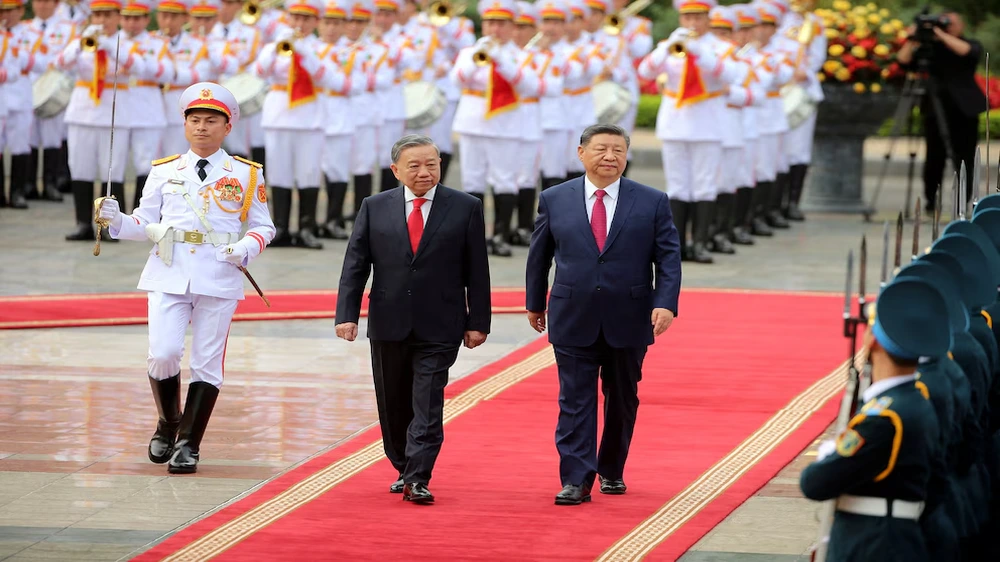

Donald Trump accused China and Vietnam of harming the United States amid tariff tensions
U.S. President Donald Trump stated on Monday that the meeting held in Hanoi between Chinese President Xi Jinping and Vietnam's top leader, To Lam, aimed to explore ways to harm the United States amid the ongoing trade war initiated by Washington.
"I don't blame China or Vietnam. I see today's meeting, and it's wonderful. It's a lovely meeting, that is, it's like trying to figure out 'how do we harm the United States'," he explained to the media in the Oval Office during a meeting with El Salvador's President, Nayib Bukele. Trump referred to the meeting between Xi and To, which took place today at the start of the Chinese leader's tour of Southeast Asia, where Beijing seeks to present itself as a reliable partner in the face of the U.S. trade offensive.
"We lost trillions of dollars in trade with China during the (former President Joe) Biden era, trillions of dollars. He let us be plucked, and we can't do that anymore. And you know what? I don't blame China at all. I don't blame President Xi. I like him. He likes me," Trump said regarding the current situation with Beijing, which he has punished for responding to the application of tariffs.
Although last week he softened his offensive with most countries, Trump decided to punish the Asian giant, which has insisted on continuing to activate retaliations, so that currently Chinese imports bear 145% U.S. tariffs, and U.S. shipments to China 125%. Trump avoided commenting when asked about the imposition of specific tariffs on semiconductors, about which he said over the weekend he would announce in the coming days, but he did insist that he would be "flexible" regarding the possibility of taxing products from the tech giant Apple, such as phones or computers.
Xi urges Vietnam to join China in opposing "bullying"
Chinese President Xi Jinping on Monday called on Vietnam to unite with China to "jointly oppose bullying," according to the Xinhua news agency, at the start of his tour in Southeast Asia, marked by the impact of U.S. tariffs.
Xi seeks to strengthen regional trade relations and tries to present himself as a reliable and stable partner, in contrast to U.S. President Donald Trump, who launched an all-out trade offensive with new tariffs, even against his economic partners.
The Chinese president arrived in Vietnam on Monday, the first leg of his tour, which will also take him to Malaysia and Cambodia.
Xi, who spoke with the general secretary of the Communist Party and de facto leader of Vietnam, To Lam, signed 45 cooperation agreements with the neighboring country, including some related to supply chains, AI, joint maritime patrols, and railway development.
"We must strengthen our strategic relations, jointly oppose bullying, and maintain the stability of the global free trade system and industrial and supply chains," the Chinese leader told Lam, according to Xinhua.
He also pointed out that "protectionism leads nowhere" and that "a trade and tariff war will have no winner," the Chinese state news agency indicated.
The new tariffs imposed by the United States on China, within the framework of the protectionist offensive undertaken by Trump, amount to 145%. This measure shook global markets and led Beijing to impose 125% tariffs on U.S. products.
In the midst of a trade war with Washington, China announced on Monday that its exports soared 12.4% year-on-year in March, exceeding expectations. The figure is more than double the 4.6% projected in a survey by the financial agency Bloomberg.
However, imports in the same period fell 4.3%, according to the General Administration of Customs of China.
(With information from EFE and AFP)
 The U.S. president reacted with irony to the meeting between Xi Jinping and To La